

A ceramic rubber steel liner can look convincing in a photograph and still leave a purchasing team with unanswered questions. What was actually tested? Was the specimen the same construction as the proposed panel? Did the result describe the ceramic, an interface, or the complete assembly? Those distinctions matter when a quotation uses the phrase impact resistant.
For procurement, the useful question is whether the available evidence supports a particular installation and operating duty. A product label cannot answer that alone. Neither can an isolated impact number, an unlabelled demonstration video, or a service-life claim from an unrelated plant.
This guide offers an original framework for evaluating supplier submissions, commissioning appropriate technical review, and defining selection boundaries. It is written for purchasing and maintenance discussions, not as a laboratory procedure or installation instruction. Start with Sanxin's ceramic wear-resistant parts, then connect the proposed assembly to a clearly documented decision.
Write down what the purchase is intended to resolve. A receiving area with repeated local damage presents a different decision from a replacement programme intended to simplify spare holdings. Both may involve composite panels, but they do not necessarily require the same evidence.
Identify the exact equipment zone, the current lining, the observed problem, and the next operational milestone. Separate the observation from the proposed explanation. A displaced panel is an observation; an unsuitable ceramic grade is one possible explanation that still requires investigation.
Next, state the decision the evaluation must support: reject an unsuitable configuration, shortlist a supplier, approve a limited trial, or release a defined production order. These decisions carry different commitments. A promising material comparison may justify further review without justifying unrestricted deployment.
Name the person responsible for technical acceptance and the person responsible for commercial release. If the evidence is inconclusive, the team should know who can request clarification and what remains on hold. This avoids converting a delivery deadline into an undocumented engineering approval.
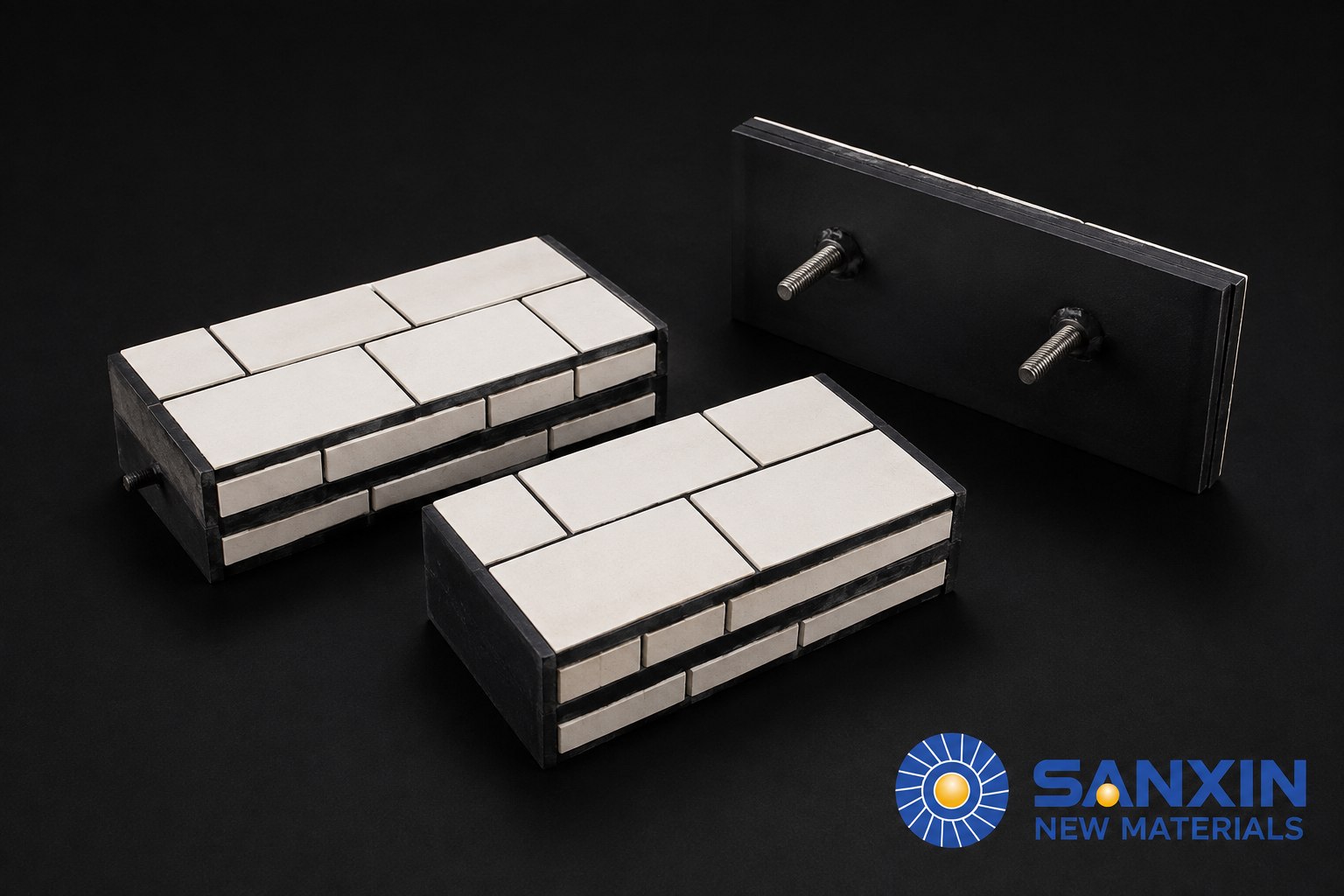
Sanxin's ceramic rubber steel three-in-one liner page describes a ceramic, rubber, and steel construction made through thermal vulcanization, with configurations discussed according to the application. That establishes a product family. The exact proposal still needs its own drawing, component identities, attachment arrangement, and confirmed operating limits.
Ask for one controlled assembly description. It should identify the ceramic arrangement, rubber compound designation, backing specification, interfaces, edge details, and fixing features. The supplier should explain which features are standard and which are specific to the quotation.
A sample described only as premium alumina on rubber is difficult to trace. Give the sample an identifier connected to the proposed configuration and the relevant manufacturing record. If a test used a different ceramic shape or backing arrangement, preserve that difference in the evaluation.
Also distinguish a material property from an assembly limit. Where published tables and descriptive text appear inconsistent, request a written clarification for the proposed product. Do not select whichever value seems more attractive, or apply a ceramic-only statement to every part of a composite panel.
Prepare a short duty description before asking suppliers to interpret impact resistance. Include the handled material, available size-distribution information, usual operating pattern, known disturbances, and where damage has been observed. Attach drawings and photographs with location labels when your organization is authorized to share them.
List the conditions that the technical reviewer needs to evaluate, including temperature exposure, moisture, relevant process chemicals, cleaning conditions, and access restrictions. Distinguish a measured value from an estimate and from an unknown. An empty field is better resolved explicitly than silently filled with a catalogue assumption.
Describe ordinary operation and exceptional events separately. A rare blockage release, foreign object, or process upset should not disappear inside an average operating description. Ask the equipment owner which events the proposed design must address and which remain outside the approved envelope.
Record future changes too. A planned throughput increase or change in feed material can invalidate a comparison based only on the current duty. The supplier should state the basis of its recommendation, while the owner confirms whether that basis matches the intended operation.
This envelope is a review document. It does not authorize changes to equipment, material trajectories, protection systems, or operating procedures.
An impact result is useful when its object, conditions, observations, and limitations are clear. Ask whether the report concerns a ceramic specimen, a bonded sample, a complete panel, or an installed assembly. Those objects answer different questions and should not share an unexplained pass label.
A demonstration video may support identification of visible events, but it should accompany a traceable report. Request the specimen identity, test organization, method reference, relevant conditions, and recorded outcome. The technical reviewer should explain how the chosen method relates to the purchasing question.
Where an energy value is reported, ask for its definition and how the laboratory determined it. A buyer should not compare two headline numbers until the responsible specialist confirms that their meanings and test conditions are comparable. A higher number alone does not establish a better installed system.
Similarly, surviving one reported event does not establish long-term service life. The evidence may support a limited conclusion about that specimen under those conditions. Keep the supplier's broader claim separate from the result that was actually observed.
Have qualified laboratory personnel and the responsible engineers design and conduct any testing under their approved controls. Do not improvise field drop tests or strike installed panels to create purchasing evidence. This guide supplies no apparatus settings, impact energies, or safe-work procedure.
ASTM's public C1421 overview concerns fracture-toughness determination for advanced ceramics at ambient temperature using defined specimens. It supports discussion of resistance to crack extension in the tested material. It does not, by its stated scope, qualify a complete rubber-backed, steel-supported liner for a plant impact duty. A laboratory should identify the applicable method and explain the relevance of its result.
ASTM's public D429 overview addresses rubber adhesion to rigid substrates, commonly metals, with specified methods and specimen arrangements. An adhesion report can contribute evidence about a relevant interface. Its applicability to a particular ceramic, rubber, and steel configuration needs review; citing the standard is not itself an impact qualification for the complete panel.
Build separate entries for material characterization, interface evaluation, panel assessment, and field observation. Link each result to the question it can address. Avoid creating one blended score in which several unrelated laboratory numbers appear to compensate for a missing assembly assessment.
Request the method designation and edition used, together with stated departures and limitations. This article refers only to public scope information; it does not reproduce the standards or prescribe testing methods.
Use a common review sheet for shortlisted suppliers. Record the proposed configuration alongside the tested configuration, then ask the technical reviewer to identify differences that affect interpretation. A report for a different product may remain useful background, but its relevance should be stated rather than assumed.
The review sheet should cover specimen identification, relevant geometry, support and attachment representation, conditioning, method, observations, and the reported endpoint. These are disclosure categories for specialist review, not instructions for assembling a test rig.
Identity: Can the report be connected to the exact sample and proposed production configuration?
Method: Is the method reference clear, with departures and limitations disclosed?
Comparison: Were the candidate and reference evaluated on a basis the reviewer accepts as comparable?
Completeness: Are all reported specimens and unsuccessful outcomes included?
Decision: What purchase or trial decision does the evidence support?
Ask for explanations when a summary chart omits this information. A supplier can sometimes close the gap with an existing report, drawing revision, or laboratory clarification. Until then, mark the conclusion unresolved.
Use the same discipline when reviewing different wear-resistant ceramic liner options. A consistent evidence request makes commercial comparisons more meaningful than a contest between isolated performance claims.
Ask the reviewer to explain how the evidence represents the proposed installation. A small sample may provide useful material or interface information without representing panel edges, fixing features, supporting structure, or transitions. The quotation should make that distinction visible.
Request a drawing review that identifies what is inside the supplier's scope and what remains the equipment owner's responsibility. A panel recommendation does not automatically approve the condition of the existing structure or a modification to the machine.
Check whether the evidence covers the same assembly revision as the quotation. If the supplier changes a component, arrangement, or manufacturing route after testing, ask for an assessment of what the previous evidence still supports. A similar appearance is not a documented equivalence decision.
The output should be a short explanation of applicability: represented features, unrepresented features, and any additional evidence required. Procurement can then distinguish an acceptable documentation gap from an unresolved issue that affects release.
A useful report describes what was found, where it was found, and how the observation was made. Ceramic cracking, local loss, interface separation, backing change, and attachment movement should remain distinct observations until the responsible reviewer interprets them.
Ask for before-and-after records associated with specimen identifiers. Where photographs are used, they should make locations and scale understandable. The report should disclose inaccessible areas or features that were not examined, rather than presenting a clean photograph as proof that every interface remained unchanged.
Keep the outcome definition close to the result. No visible detachment, no observed crack, and compliance with an agreed dimensional criterion are different statements. A pass label without the underlying criterion is difficult to use in a purchasing decision.
When investigation is needed, agree who retains the specimen and records, who reviews them, and how the conclusion will be documented. Do not reclassify every unexpected observation as operator error or material failure without supporting evidence.
Ask whether the reported specimen condition is relevant to the intended duty. The laboratory and engineering team should decide whether any environmental conditioning or repeated-exposure assessment is necessary, and how its results should be interpreted.
For procurement, the task is to make the evidence boundary visible. Was the sample new or previously exposed? Were relevant conditions recorded? Does the report describe a single observation or a sequence? Are differences between laboratory conditions and the proposed service acknowledged?
If the available report addresses only a new specimen, record that limitation. Do not infer a maintained level of performance throughout the service period. Equally, do not invent a degradation factor to turn an incomplete report into a numerical forecast.
Ask what would trigger renewed review: a change of compound, process environment, operating pattern, or observed damage. Documenting those triggers gives the future maintenance team a practical reason to reopen the selection decision when its assumptions change.
Have the owner and responsible specialists agree what evidence is required for each release decision. Criteria should be connected to the defined duty and consequences of an unacceptable result. Procurement should not choose technical limits simply because one supplier can meet them.
Separate mandatory conditions from preferences. A missing configuration identity may prevent evaluation altogether, while an incomplete presentation format may be corrected administratively. Treating both as equal checklist failures wastes time and obscures the substantive issue.
A practical decision record can use four outcomes: sufficient for the stated release, sufficient for a limited trial, additional evidence required, or unsuitable for the proposed scope. Add the reason, responsible reviewer, and any conditions attached to the decision.
Keep the original criteria when evaluating results. If a criterion needs revision, document the technical reason and apply the revised basis consistently. Do not quietly redefine success after seeing a result that would otherwise be inconvenient.
Metso's ceramic wear-liner overview describes application conditions for its own products, including sliding wear and impact-angle considerations. That manufacturer-specific guidance illustrates why a general material label should not be treated as permission for every impact duty. It supplies no rating or guarantee for a Sanxin assembly.
Keep alternatives open until the duty and evidence are reviewed. Ask the supplier to explain why the proposed construction addresses the identified problem and what would favour another arrangement. Avoid a specification that names a preferred material before defining the conditions it must satisfy.
Different zones within one asset may need separate review. Do not extend a recommendation for one replaceable panel across an entire chute, hopper, or machine without checking the changed conditions and interfaces.
If the evidence does not support the proposed use, the appropriate next step may be a different configuration, an equipment review, or a narrower trial. Selecting another solution can be a successful evaluation outcome.
Organize the submission around the purchasing decision, with a configuration sheet, applicable drawings, supporting reports, proposed inspection deliverables, and a list of exclusions. Give each document a revision identifier so that the accepted package remains distinguishable from earlier discussions.
Ask the supplier to link each significant performance statement to its supporting document. Where information is unavailable, request a direct statement of the gap and its proposed resolution. A concise, traceable package is easier to assess than an extensive collection of unrelated certificates and photographs.
For the shortlisted ceramic wear protection components, confirm what will be checked at receipt and what can only be checked during installation or operation. The responsible teams should agree how deviations are recorded and who can accept them.
Do not treat a company-level quality certificate as evidence that a particular panel passed a particular test. Verify document identity, scope, and relevance before using it in the release decision.
Where specialist review supports a trial, write the unresolved question before installation. The purpose might be to assess maintainability in an approved location or to obtain comparable condition records. It should not be an open-ended attempt to discover a failure limit during production.
The owner should approve the location, operating boundaries, inspection arrangements, and responsibilities through its normal engineering and safety processes. Establish the starting condition and retain the approved configuration so later observations can be interpreted.
Record operating exposure from available plant data and separate routine conditions from unusual events. Missing information should remain visible. Do not turn estimated throughput into a precise wear comparison or claim a completed service life for a component still operating.
Review the trial against the original question. A favourable observation can support the next defined decision while still leaving limitations. It does not automatically validate other zones, changed operating conditions, or every product in the same family.
Compare quotations only after identifying what each includes. Panel quantities, drawings, inspection documents, attachment components, transport arrangements, and responsibilities may differ. An apparently lower price can refer to a different supply boundary.
Ask suppliers to state which technical clarifications must be closed before manufacture. Keep conditional proposals distinct from approved configurations, and confirm delivery commitments against the agreed scope rather than an early enquiry.
For lifecycle discussions, use verified costs and clearly labelled scenarios. Do not promise avoided downtime or replacement savings from an impact test alone. Those commercial outcomes require their own operating records and assumptions.
Include change control in the order documentation. Agree how substitutions, drawing revisions, and evidence gaps will be reviewed. The accepted configuration should remain traceable from the purchase decision through delivery and subsequent assessment.
No single material value establishes suitability for a complete installed liner. Ask the technical reviewer which evidence is relevant to the proposed assembly and duty, and what remains unresolved.
Only after qualified review confirms a comparable basis. The report needs the specimen identity, method, relevant conditions, endpoint, and limitations. Different numbers may describe different questions.
A laboratory result supports a conclusion within its stated conditions. Field life and any contractual guarantee require a separate basis. Keep laboratory evidence, operating observations, and commercial commitments distinct.
Record the gap and request an appropriate technical proposal to resolve it. Depending on the decision and approved scope, that may involve further assessment, a limited trial, or another configuration. Missing evidence should not become an assumed pass.
Send Sanxin New Materials a clear asset description, the available duty information, labelled observations, and the decision you need to make. Identify required drawings, evidence, exclusions, and the people responsible for technical review.
Use the ceramic wear-resistant parts range to begin the discussion, then request a proposal tied to your application. A useful response connects a defined assembly to relevant evidence and explicit limitations. That connection provides a stronger basis for purchasing than an unsupported claim of universal impact resistance.

Envie sua demanda,
entraremos em contato o mais rápido possível.

Sanxin Novos Materiais Co., Ltd. foco na produção e venda de grânulos cerâmicos e peças como meios de moagem, contas de jateamento, esfera de rolamento, peça de estrutura, forros cerâmicos resistentes ao desgaste, nanopartículas nano pó


 Inglês
 Inglês
 Russo
Russo Francês
 Espanhol
 Português
 Árabe
Árabe