

A ceramic lined pipe project should begin with a transport problem, not a promise about service life. A plant may need fewer unplanned interventions, better control of material loss, or a replacement schedule that fits its shutdown calendar. Those goals require more than a harder internal surface. The pipe assembly must also suit the conveyed material, operating envelope, existing connections and maintenance practices.
This guide from Sanxin New Materials explains how to develop a practical retrofit specification for abrasive conveying lines. Its focus is the complete project: identifying a suitable application, collecting useful site information, comparing proposals, planning installation and deciding whether a trial has earned a wider rollout. The examples are hypothetical planning scenarios, not accounts of named customer installations or guarantees of performance.
Sanxin's ceramic wear-resistant parts range includes several pipe and lining constructions. Treat that range as a starting point for discussion. The right specification still depends on the particular line and should be confirmed in the quotation and approved drawings.
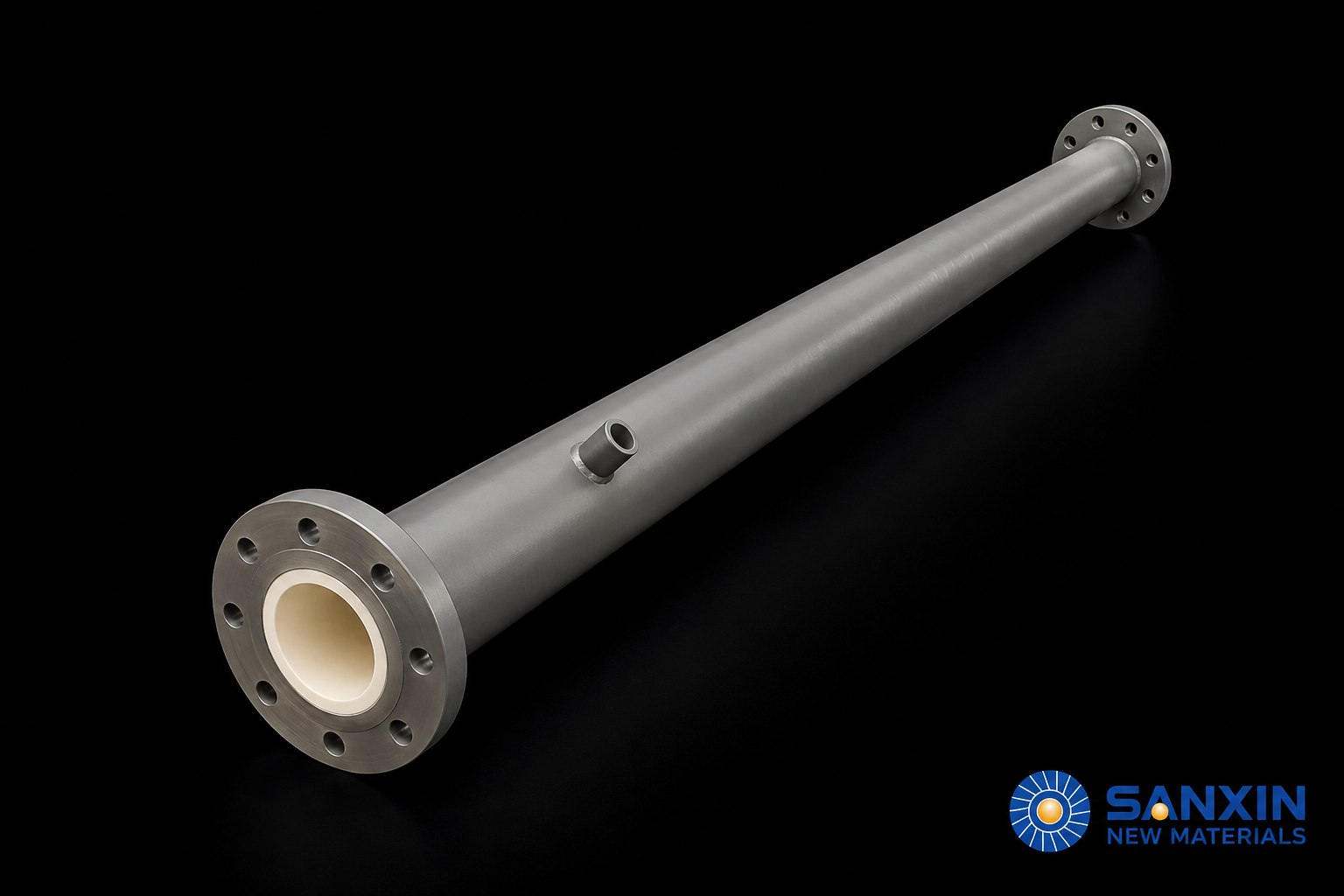
“Replace worn pipe” is too broad to guide a useful enquiry. Describe what actually makes the existing arrangement unacceptable. Is the plant experiencing recurring leakage at one location, unexpected shutdowns across an entire route, restricted access for repairs, or increasing replacement expenditure? Identify the operational consequence as well as the damaged component.
Separate repeated symptoms from established causes. A worn-through area is evidence of damage; it does not, by itself, prove which material or construction will solve the problem. Record whether removed parts show gradual surface loss, damaged edges, loose lining, deformation, or failure at a connection. Photographs should include orientation and a scale.
Agree on a project objective before comparing suppliers. A useful objective might be to complete a scheduled production campaign without an unplanned pipe intervention, while maintaining an agreed throughput. Another might be to make a difficult section replaceable during a normal maintenance window. Avoid an objective framed only as a universal life multiplier.
Prepare a simple route drawing that identifies individual straight spools, direction changes, branches, reducers, supports, instruments and accessible inspection points. Assign a unique reference to every proposed replacement. Mark the direction of flow and distinguish existing dimensions from measurements that still need checking.
Include more than the nominal diameter. Ask the project engineer to confirm the required finished bore, connection details, face-to-face dimensions, available installation envelope and allowable assembly weight. A quotation based on the outside dimensions of an old steel spool may not describe the same usable flow passage after lining.
Create a second layer showing maintenance history. Put the replacement date, damage location and available operating information beside each affected spool. This makes it easier to select a manageable first trial instead of replacing unrelated sections simultaneously. Keep uncertain observations clearly labelled; estimates should not quietly become manufacturing dimensions.
Consider a hypothetical plant with an abrasive dry ash line and recurring maintenance at several accessible spools. The first question is whether the records describe the same duty each time. Ask the operations team for conveying mode, solids throughput, air conditions, operating hours and any changes in ash source.
Document normal operation and unusual events separately. Frequent starts, interrupted feed, cleaning procedures and blockage recovery may deserve different attention from steady production. Ask the equipment owner which conditions are relevant to its system; do not assume that a nominal daily tonnage captures every demanding event.
A practical pilot could cover one documented problem section together with its immediate connection interfaces. Record the condition of adjacent parts before the change. Otherwise, damage found downstream later might be incorrectly described as either a new failure or a benefit of the lining.
Choose inspection timing with the plant's responsible engineer. The trial should not be left unobserved simply because the new lining looks substantial. Sanxin lists ash-related duties among the applications for its alumina ceramic tubes and pipes; application suitability and assembly limits still need project-specific confirmation.
For a hypothetical mineral processing line, define the slurry rather than describing it only as “ore.” Request available information on solids concentration, particle size distribution, mineral composition, operating temperature and chemistry. Record how these conditions vary between production campaigns.
Identify the line's operating and design requirements through the plant's piping authority. The ceramic lining is a wear component within an assembly; it is not a substitute for confirming the required pressure boundary, connections and support design. Do not infer an assembly rating from a ceramic material data sheet.
Plan how the new section will be drained, isolated, inspected and replaced. The best place to assess lining condition may not be the easiest place to reach during production. Agree on safe access and a repeatable inspection method before ordering, with the work governed by the site's procedures.
Where movement or a flexible connection is involved, ask for a separate suitability assessment. Sanxin's rubber-integrated ceramic pipe information describes a different construction from a rigid ceramic lined steel spool. The presence of ceramics in both products does not make them interchangeable. Connection geometry, movement limits and duty approval belong in the written specification.
A hypothetical cement plant retrofit often starts with an existing route that cannot easily be moved. Build the enquiry around those fixed interfaces: connected equipment, support locations, access platforms and the available lifting route. Distinguish dimensions confirmed during a shutdown from those estimated from older drawings.
Ask operations to describe the specific material stream. Raw meal, finished cement and another process powder should not be treated as identical solely because they pass through similar-looking pipework. Include operating temperature, expected transients, material condition and any cleaning or maintenance practices relevant to the assembly.
Avoid evaluating only the replacement spool. Check the transition into the next component and the available space for fasteners and tools. A lining project should have a clear boundary, but that boundary should not hide an unresolved interface that prevents correct installation.
For an early trial, choose an accessible section with meaningful maintenance records and a realistic observation period. An undocumented location may produce an impressive photograph without producing a reliable purchasing decision. Define success in terms of the plant's actual objective, not a performance number borrowed from another installation.
Request a section drawing that identifies the outer structure, ceramic geometry, joining or bedding layer, and end treatment. Ask the supplier to explain which elements are included in its offer and which remain the responsibility of the installer or equipment owner.
Sanxin's integral ceramic pipe page describes an assembly combining an outer steel pipe, formed ceramic fittings and a filling or bonding arrangement. Its adhesive ceramic lining pipe page describes a bonded ceramic-and-steel construction. These descriptions help identify the product family; they are not a complete project specification.
Compare proposals using the same drawing and operating envelope. If one supplier offers a different construction, ask it to state the difference explicitly. A lower price may represent a different bore, ceramic coverage, connection scope or inspection package rather than an equivalent alternative.
Material composition remains useful, but it should not carry the whole decision. Ask for the grade designation, relevant test method and the specific evidence supporting suitability. Keep any unconfirmed characteristic open until the supplier provides an answer.
Create a short data sheet separating normal, minimum, maximum and upset conditions. Use the units familiar to the project team, but make them explicit. Identify whether each value is measured, specified by design, estimated or not available.
Include the transport medium, solids information, operating schedule and required connection standard. Ask the responsible engineer which temperature, pressure, vacuum, chemical exposure and external environmental conditions must be considered. The completed assembly should be assessed against that envelope, not just the ceramic surface.
Pay particular attention to the weakest unconfirmed component. A high temperature statement about a ceramic body does not establish the allowable temperature of an adhesive, rubber layer, gasket or finished pipe assembly. Obtain written assembly-specific limits and installation requirements instead of combining unrelated catalogue figures.
Turn “good quality” into a list of agreed deliverables. Request an approved drawing revision, a component identification scheme, the specified materials, required dimensional checks and an inspection record linked to the supplied items. Clarify whether photographs, material certificates or witness points are included.
Specify which dimensions matter at the interfaces. Finished bore, connection orientation, overall length and end details may require separate acceptance criteria. Ask the engineering team and supplier to agree on tolerances suitable for the installation; do not import a generic percentage from an unrelated article.
Agree on the treatment of visible chips, cracks, gaps or other irregularities before dispatch. The acceptance decision should follow the approved criteria and the supplier's technical assessment, rather than an improvised judgement at the receiving dock.
Where pressure or leak testing is required, the responsible engineer must define the applicable procedure, test medium, acceptance criteria and documentation. Do not apply a generic test multiplier to every lined assembly. This guide is a purchasing framework, not a pressure-test instruction.
Label each package so the receiving team can connect it to the line map and drawing revision. Ask for a packing list that distinguishes supplied spools, loose components and recommended installation materials. Confirm how orientation marks will remain visible during handling.
At receipt, compare identification and dimensions with the order before releasing the parts to the work area. Photograph the packaging and accessible lining surfaces. If damage or an unexpected difference is found, isolate the affected item for assessment rather than accepting it simply to keep the shutdown schedule moving.
Follow the supplier's handling and storage instructions. Plan lifting equipment around the documented assembly weight and approved lifting method. The installation crew should not need to invent a handling arrangement after the delivery vehicle arrives.
List the activities included in the supply contract and those retained by the plant or contractor. Common areas requiring clarification include field measurement, removal of old parts, support changes, connection materials, alignment checks, installation supervision and final acceptance records.
Ask the supplier to provide instructions for the delivered construction. A method suitable for one type of lining should not automatically be used for another. Any proposed cutting, welding, heating, drilling or local repair needs approval from the appropriate engineering parties before work begins.
Use the site's established isolation, lifting and commissioning procedures. This article does not replace them. The retrofit plan should name the person responsible for resolving discrepancies and the point at which work must pause for an engineering decision.
A purchase-price comparison answers only one question: what the quoted items cost. A project decision may also need freight, installation labour, lifting equipment, inspection, planned downtime and disposal costs. Record which costs are included so competing proposals are not evaluated on different boundaries.
For an illustrative calculation, suppose the existing arrangement costs $2,000 per replacement event and requires four events in a year. Its annual replacement expenditure would be $8,000. Suppose a proposed retrofit requires $6,000 installed and a further $1,000 for inspections during that year. Those assumptions produce a first-year comparison of $8,000 versus $7,000, before other costs.
This is arithmetic for explaining the method, not a Sanxin price, quotation or service-life forecast. If the proposed assembly requires an additional intervention, or the baseline has fewer replacements, the conclusion changes. Test a conservative scenario instead of treating the most favourable estimate as the expected outcome.
Keep downtime valuation separate unless the plant can substantiate it. A maintenance hour is not automatically an hour of lost saleable production. Use the site's own operating and financial records, and label unavailable values rather than inventing savings.
Select a location where the duty and previous maintenance pattern are reasonably understood. Define the trial start, planned observations, responsible people and criteria for expanding, modifying or ending the trial. Store these decisions with the original enquiry.
Measure exposure in a way that fits the process. Calendar time can be reported, but also record available operating hours or material throughput. A pipe used intermittently and one used continuously should not be compared solely by months since installation.
Keep an operating-change log. A change in material, transport settings, production rate or upstream equipment can affect the interpretation of the result. Record these events even when the trial appears successful; favourable findings need the same discipline as unfavourable ones.
At review, distinguish an observed outcome from a prediction. “No unplanned intervention during the documented trial period” is a bounded statement. “Will operate for years without maintenance” is a forecast that the same observation does not establish.
A successful pilot does not remove the need for spares. Decide which components should be stocked, which can be ordered to a confirmed drawing, and which require a new site survey. Ask for lead-time confirmation when planning the actual purchase rather than relying on an old enquiry.
Consider whether spool dimensions can be standardized without compromising the engineering design. A smaller set of approved configurations may simplify identification and replacement, but do not force different duties into one specification merely to reduce the number of part codes.
Retain the final drawings and inspection records in a location accessible to maintenance and purchasing. If a later order references only a photograph or an informal product name, useful knowledge from the trial can be lost.
Make the installed configuration easy to identify after the project team has moved on. The handover should connect each spool number to its location, approved drawing, installation date and available inspection evidence. Record deviations that were formally accepted rather than quietly editing them out of the history.
Give maintenance staff a short list of observations to record during planned checks, using the inspection approach approved for the assembly. Keep the wording consistent between shifts. “Surface condition unchanged from the previous photograph” is more informative when the photograph location and date can both be found.
Arrange a review if the process changes materially. A specification accepted for one feed or operating pattern should not be assumed to cover a different duty indefinitely. The purpose of this record is to make future decisions traceable, not to create paperwork that nobody can locate.
Prepare one enquiry package containing the line map, marked photographs, current drawings and a brief description of the operating problem. Include the data sheet and distinguish confirmed information from outstanding questions.
List the required supply scope, quantity, desired delivery window and inspection documentation. Ask for a proposal that identifies assumptions, exclusions and any technical information still needed. An explicit unanswered question is more useful than an apparently complete quotation based on a hidden assumption.
Start with the wear-resistant ceramic parts product range and identify the relevant pipe construction when contacting Sanxin New Materials. Request confirmation of available dimensions, material grade, assembly limits and manufacturing lead time for your project. Do not treat a general website description as a signed technical agreement.
Sanxin lists pipe and tube applications covering power generation, mining, mineral processing and cement-related handling. These are application categories, not automatic approvals for every process stream. Confirm the actual material, operating envelope, connections and inspection needs before specifying an assembly.
Possibly, but it requires dimensional and engineering review. Check the finished bore, connection locations, installation envelope and support requirements. A retrofit drawing should show what remains unchanged and what must be modified, rather than relying on the nominal pipe size alone.
Thickness is one design variable, not a complete performance specification. Ask how the proposed geometry fits the required bore, attachment arrangement and operating conditions. Compare the entire approved assembly and its supporting evidence instead of ranking quotations by thickness alone.
There is no defensible universal answer for every line. Request relevant evidence and define a monitored trial under your conditions. Report what the trial actually demonstrates, including its duration and operating exposure, and keep longer-term expectations clearly identified as estimates.
Not necessarily. A staged approach can help a plant validate installation details and establish evidence before committing to a wider replacement. The responsible engineering team should decide whether a partial retrofit is suitable and whether adjacent interfaces need simultaneous changes.
For a pipe-related application, the image should show the relevant cylindrical lining, curved segment, end face or assembled spool clearly enough to understand the product form. An illustrative image is not dimensional evidence. Use approved drawings and actual inspection records for engineering acceptance.
The strongest ceramic lined pipe proposal connects the application, assembly design, installation requirements and acceptance plan. It explains what is known, what still needs confirmation and how the plant will determine whether the investment meets its objective.
For ash, slurry or cement handling, begin with one clear problem and a usable enquiry package. Discuss the corresponding ceramic wear-resistant parts with Sanxin New Materials, confirm the project details in writing, and use a measured trial to guide the next stage. That process produces a more reliable decision than an impressive but unverified promise about lifetime.

Envie sua demanda,
entraremos em contato o mais rápido possível.

Sanxin Novos Materiais Co., Ltd. foco na produção e venda de grânulos cerâmicos e peças como meios de moagem, contas de jateamento, esfera de rolamento, peça de estrutura, forros cerâmicos resistentes ao desgaste, nanopartículas nano pó


 Inglês
 Inglês
 Russo
Russo Francês
 Espanhol
 Português
 Árabe
Árabe