

A ceramic lined pipe service-life claim is useful only when a buyer knows what was measured, what the comparison represents, and what ended the service period. A laboratory wear result, a photograph of an intact liner, and a maintenance record answer different questions. Treating them as interchangeable can turn an attractive quotation into an unreliable replacement plan.
For an industrial buyer, the practical objective is not to find the largest lifetime multiplier. It is to establish whether a proposed lining system can meet a defined operating requirement with an acceptable inspection burden and manageable uncertainty. That requirement might be reaching a planned shutdown, reducing repeat failures at one bend, or making replacement dates more predictable.
This guide presents an independent evaluation framework for discussions with Sanxin New Materials and other project stakeholders. It does not promise a particular operating life. Start with the relevant ceramic wear-resistant parts, then connect the proposed construction to your own operating history, trial measurements, and replacement criteria.
Write the endpoint before requesting a lifetime estimate. Does service life end at a specified lining condition, a confirmed loose component, an unacceptable contamination result, a leakage event, or a planned preventive replacement? Do not deliberately run a pipe assembly to leakage or failure; follow the site's approved inspection, intervention and safety criteria. These are not equivalent endpoints. A comparison between a pipe replaced preventively and one operated until failure can exaggerate the apparent difference between products.
Separate observed life from expected life. Observed life describes an asset that has reached the agreed endpoint. Expected life is a forecast based on assumptions. An asset that remains in service has an observation period, not a completed lifetime. Its record should say that it was still operating at the latest inspection.
For a purchase specification, use a sentence such as: “Evaluate whether the trial assembly can remain within the project’s approved condition criteria through the next planned maintenance window.” Add the operating exposure, inspection responsibilities, and evidence needed for the decision. Have the responsible plant engineer define the actual condition criteria; this article does not provide pressure-boundary retirement limits.
Also state whether the question concerns one replaceable spool or an entire route. Improving a selected section does not establish the lifetime of adjoining elbows, seals, branches, or connections. Keep the claim no broader than the equipment that was actually evaluated.
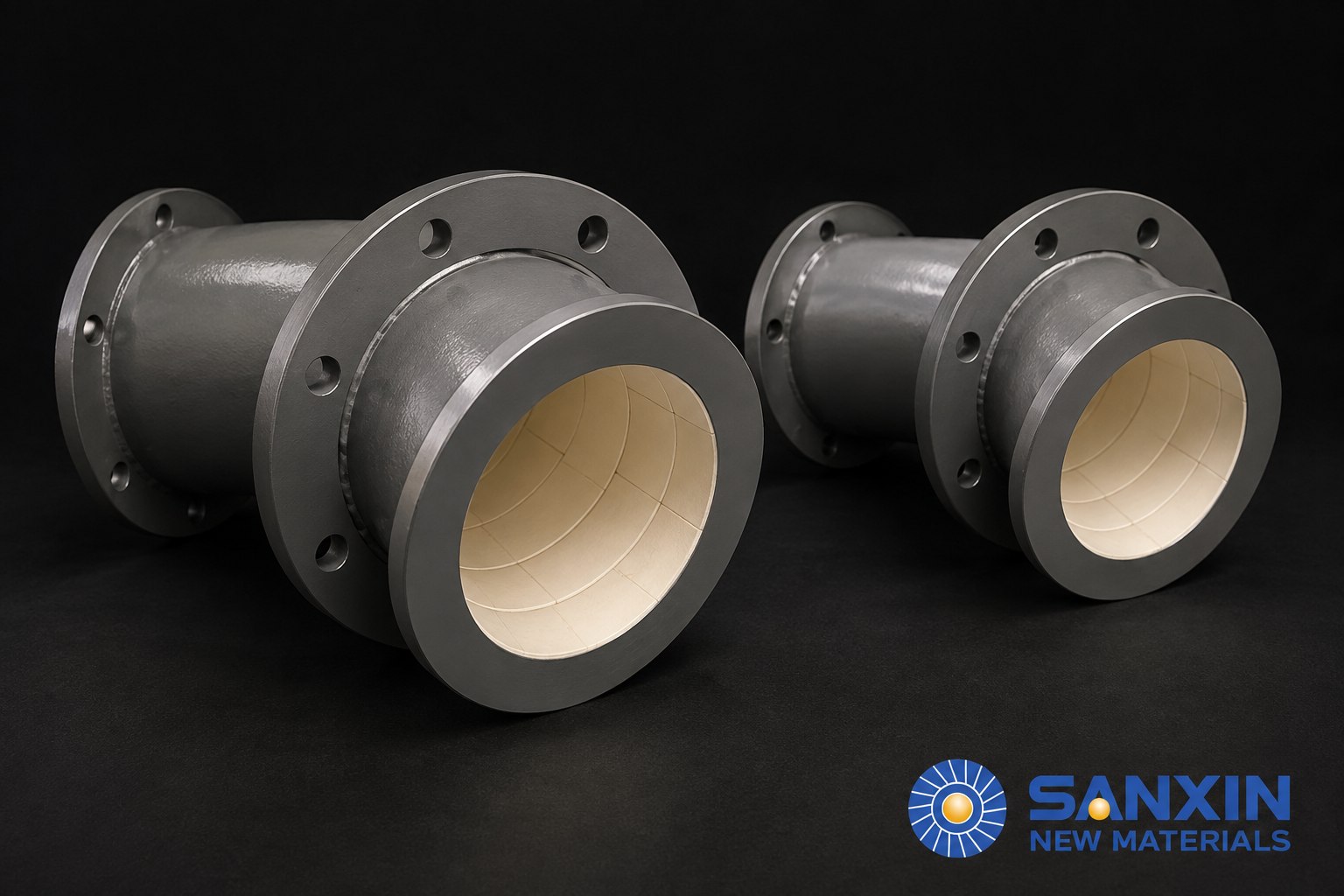
A material specimen is not a complete lined pipe. The supplied assembly includes its ceramic geometry, interfaces, supporting structure, joints, and manufacturing condition. Sanxin’s integral ceramic pipe product information describes a construction combining an outer steel member, formed ceramic, and a bonding layer. The project review must consider the assembled configuration rather than relying on a ceramic material label alone.
Ask the supplier to identify which evidence belongs to the ceramic material and which belongs to the complete assembly. A material test may inform selection without establishing joint performance. An assembly inspection may confirm dimensions without establishing long-term wear behavior. A factory photograph may show workmanship without proving performance in your process.
Build a simple evidence register with separate entries for material identity, assembly drawing, manufacturing checks, operating suitability, and field observations. Mark missing entries as “not provided,” not “assumed satisfactory.” This makes the remaining questions visible before a commercial decision becomes difficult to reverse.
When reviewing wear-resistant ceramic lining options, request the exact proposed configuration. Avoid mixing a laboratory report for one formulation, a photograph of another construction, and a lifetime estimate from a third application into a single implied qualification.
Begin with an observation sheet rather than a preferred grade. Record where damage appeared, how it developed, which process changes preceded it, and what maintenance personnel actually found. Separate photographs and measurements from interpretations. “Local damage near the branch entrance” is an observation; “the ceramic was unsuitable” is a conclusion that requires additional evidence.
Give every inspected location a repeatable identity. Include the asset tag, flow direction, installed orientation, and reference points used for photographs or measurements. A statement that “the elbow wore quickly” is difficult to investigate if the replacement was rotated or its orientation was not recorded.
Map local defects separately from general surface change. A single damaged edge should not disappear inside an average measurement for the whole component. Likewise, a local observation should not automatically be presented as the condition of an entire route.
Structure the investigation around questions: Is the observed change consistent across the surface? Is damage concentrated at an interface? Did the operating duty change? Was an obstruction or handling event reported? Are inspection methods comparable between visits?
These questions do not establish a failure mechanism by themselves. They help the responsible technical team decide which evidence to request next. Preserve removed parts and relevant records when practical, and avoid rewriting the original observations after a preferred explanation emerges.
ASTM’s public description of G76 concerns erosion testing with gas-carried solid particles. It states that laboratory rankings are tied to test conditions and that their relationship to field behavior needs assessment. A single test is therefore not an automatic prediction of service performance. This is a limitation of interpretation, not an instruction to disregard laboratory evidence. See ASTM’s G76 overview.
ASTM’s G65 overview describes a dry sand and rubber wheel method for scratching abrasion of metallic materials. It reports results as volume loss and explains that the method does not reproduce every service condition. If a quotation cites G65 for a ceramic comparison, ask how the specimen, procedure, and any departures were handled; do not assume the citation alone establishes equivalent applicability. See ASTM’s G65 overview.
For either type of report, request the specimen identity, test date, procedure designation, preparation, exposure conditions, measurement units, and repeat results. Ask the laboratory or supplier to explain why that method addresses the dominant question in your application.
Keep the test report attached to its limitations. A chart stripped of specimen details may be convenient for a sales presentation, but it is a weak basis for selecting a replacement interval. The purchasing decision should remain traceable to the complete report that the technical reviewer accepted.
A statement such as “twenty times longer” needs a defined numerator and denominator. Ask whether it describes laboratory volume loss, laboratory mass loss, operating hours, transported tonnage, or completed service intervals. A ratio for one measure cannot simply be renamed as another.
When materials have different densities, identical mass losses do not represent identical lost volumes. Ask for density and the conversion basis when a comparison uses mass loss to discuss dimensional wear. Even a correctly calculated volume-loss ratio does not account for the usable thickness or assembly condition that determines a particular replacement decision.
Use a five-question claim check:
What exactly was measured, and in which units?
What materials and assembled configurations were compared?
Were exposure and endpoint definitions equivalent?
How many observations support the claim, including unsuccessful trials?
Does the proposed purchase match the conditions behind the evidence?
If the answers are incomplete, retain the statement as an unverified claim rather than a design input. It may justify a targeted trial, but not a guaranteed maintenance schedule.
Do not make a supplier’s historical project your own company’s case study. For a Sanxin project, use Sanxin-specific documentation where available and label unrelated information as background. If no comparable field record is provided, say so directly and design the next evaluation around that gap.
A strong comparison starts before the new component arrives. Gather the existing asset’s purchase description, installation date, replacement date, operating exposure, inspection notes, and recorded reason for removal. If any field is missing, keep it missing in the analysis rather than reconstructing it from an uncertain recollection.
Check whether the old component was representative. A pipe damaged during an unusual event is not necessarily a fair baseline for routine abrasive service. Conversely, excluding inconvenient failures without a documented reason can make the existing arrangement look better than it was.
Ask operations to identify changes in feed material, operating schedule, flow settings, cleaning practices, or upstream equipment during the observation period. Record known changes without inventing a numerical correction. An unexplained change is a comparability limitation that should remain visible.
Where several historical components are available, preserve their individual records. Report the range and reasons for variation instead of only selecting the shortest or longest example. A maintenance planner needs to understand inconsistency as well as average performance.
Finally, define the commercial problem separately from the technical baseline. Unexpected labor demand, constrained access, and spare-part availability may matter even when a lifetime increase is uncertain. Keeping those factors separate prevents a financial preference from becoming an unsupported performance claim.
The best trial is not always the longest. It is one with a clear decision, an interpretable comparison, and inspection opportunities that fit the plant’s approved procedures. Write a one-page protocol before installation so the parties agree what evidence will support continuation, modification, or rejection.
A parallel location may be useful, but nearby does not automatically mean equivalent. Document route geometry, material handled, operating exposure, and any known differences. A sequential trial on the same location also has limitations if the process changes between the baseline and candidate periods.
If equivalent comparison is not practical, describe the trial as a feasibility observation. It can still reveal installation or monitoring issues, but it should not produce an overly precise ranking between alternatives.
Coordinate inspections with the responsible site team. The schedule should reflect the approved operating and safety plan, access constraints, and the uncertainty being investigated. Do not choose intervals merely to make the trial appear more convenient or successful.
Record the installed condition before service begins. Later observations need that reference to distinguish pre-existing features from change in service. Include photographs, approved measurement locations, instrument information, and any limitations in access or visibility.
Name who can decide that the trial requires review and who authorizes continued operation. Keep those decisions within the plant’s engineering and safety system. Supplier participation does not replace the operator’s responsibility for the equipment.
Calendar months alone can obscure differences in operating duty. Record elapsed time and, where reliable records exist, operating hours and material throughput. Do not calculate a throughput-normalized result from a guessed tonnage figure.
Pair exposure metrics with condition observations. A trial may have substantial operating exposure while a critical area remains uninspected. Conversely, a detailed inspection after minimal exposure may confirm installation condition without yet establishing a useful wear trend.
Consider the following record structure:
Asset and configuration: identify the exact component and approved drawing revision.
Exposure: record dates, operating hours, throughput, and data completeness.
Condition: record location-specific measurements and visible findings.
Events: note process changes, interruptions, maintenance, and unusual observations.
Decision: state the review outcome, evidence used, and unresolved questions.
Keep measurement resolution and repeatability in view. If an apparent change is too small to distinguish confidently from measurement variation, report it as unresolved. Do not turn a nearly unchanged reading into a claim of unlimited life.
Photographs are supporting evidence, not a substitute for every measurement. Use consistent viewpoints and labels, while acknowledging surfaces that cannot be seen. The goal is a transparent condition record, not a collection of persuasive images.
A remaining-life estimate should state its starting condition, assumed future exposure, chosen trend model, and retirement criterion. Without those elements, a date is an opinion rather than an auditable forecast.
A simple trend can be useful for planning discussions when the responsible engineer judges the measurements and mechanism suitable. However, do not automatically extend an early trend across the entire service period. A change in operating conditions, local damage, or a different limiting component can make the extrapolation inappropriate.
Present at least a conservative planning case and a central working case, with the assumptions written beside them. If evidence is insufficient to support either, use “not yet estimable.” That answer is more useful than a precise number that cannot survive technical review.
Keep forecasts distinct from commitments. A planning estimate may guide inspection preparation, while a purchase agreement may contain separately negotiated performance obligations. Neither should be silently substituted for the other.
Update the estimate when new measurements or operating information arrive. Preserve earlier versions and explain why the estimate changed. This helps future teams distinguish a genuinely informative forecast from one that was repeatedly revised after the outcome was already known.
Create a decision calendar alongside the maintenance calendar. The decision calendar asks when evidence must be reviewed, when a spare must be ordered, and when access or installation resources must be reserved. These milestones may occur well before the expected replacement date.
Check the supplier’s confirmed manufacturing and delivery lead time for the actual configuration. Do not substitute a generic catalogue lead time for a project-specific commitment. Include review, transport, receiving inspection, and site preparation in the planning discussion.
Define what happens if an inspection is inconclusive. Possible responses include obtaining an additional approved assessment, revising the observation plan, or bringing forward a planned intervention. The appropriate response belongs to the responsible site team and depends on the asset’s consequences of failure.
For critical locations, discuss spare compatibility before purchase. Confirm which drawings, dimensions, interfaces, and handling provisions define an interchangeable replacement. A longer expected wear life does not remove the need for a recoverable maintenance plan.
The objective is predictable decision-making under uncertainty. A realistic plan with explicit review points is more valuable than a confident lifetime statement with no provision for an unexpected result.
Use the same assessment period and operating assumptions for each option. Include the purchase price, verified installation requirements, inspection effort, expected replacement work, and other costs your organization actually tracks. Distinguish quoted amounts from internal estimates.
A simple comparison can start with total evaluated cost divided by the supported operating exposure. Keep currency and units consistent. If exposure is forecast rather than observed, label the result as a scenario, not an achieved cost saving.
Show sensitivity to the uncertain variables. Ask how the preferred option changes if its service period is shorter than expected, delivery takes longer, or installation requires additional work. This is often more informative than reporting one attractive payback figure.
Do not assign a generic monetary value to avoided downtime. Use an estimate approved by the owner of the production or finance data, and avoid counting the same lost production twice under different cost headings.
Similarly, do not claim energy savings from a smoother-looking bore or a product photograph. Any energy comparison requires a separate measurement plan and appropriate operating context. Wear evaluation and energy evaluation can inform the same purchasing decision without being treated as the same evidence.
Prepare a concise enquiry that identifies the asset, process material, current construction, observed problem, available baseline, and decision deadline. Add drawings and photographs that your organization is permitted to share. State what is unknown instead of leaving the supplier to infer it.
For the proposed ceramic lined pipe wear components, request the configuration, material identification, relevant inspection records, proposed evidence of suitability, and any comparable field information that can be disclosed. Ask the supplier to separate confirmed characteristics from application-dependent expectations.
Use the response to create a question list for the technical review. A missing report does not automatically disqualify a proposal, but it should lead to an explicit action: obtain evidence, narrow the claim, revise the evaluation, or decline the unsupported assumption.
Keep commercial and technical approvals connected. A revised configuration, material, or interface may require another technical review even when the price is unchanged. Preserve the accepted revision so procurement, receiving inspection, and the trial team are evaluating the same product.
There is no defensible universal answer for every assembly and process. Define the operating exposure and replacement endpoint, review comparable records, and evaluate the proposed configuration. If only laboratory data are available, use them to inform qualification rather than converting them directly into a calendar-life guarantee.
Not by itself. The measured property, specimen configuration, exposure, and comparison material must be understood. A field-life claim also needs evidence about the assembled product and the endpoint used in service. Keep laboratory rankings and completed field observations separate in the purchasing record.
A composition label is one input, not a complete purchase specification. Request the proposed geometry, supporting assembly, relevant evidence, and operating limitations. Select the configuration through a documented technical review rather than treating one material descriptor as proof of total system reliability.
Report the observed exposure and latest condition, with the statement that the component remains in service. Do not call that exposure its final lifetime. It may support a planning update, but longer-term claims still depend on future evidence.
Provide an identifiable component, a repeatable damage location, known operating exposure, dated condition records, and the maintenance decision you need to make. Clear baseline information usually produces a more useful technical discussion than a request for an unsupported maximum lifetime.
Reliable ceramic lined pipe service-life evaluation connects a defined endpoint, a credible baseline, relevant testing, and an interpretable site trial. It also keeps unknowns visible and separates measured outcomes from forecasts.
Use Sanxin New Materials’ wear-resistant ceramic parts range to begin a configuration-specific enquiry. Bring the evidence that describes your actual wear problem, ask for the evidence that supports the proposed assembly, and agree how the next decision will be made. The result should be a replacement plan your maintenance and procurement teams can explain, verify, and update.

Envie sua demanda,
entraremos em contato o mais rápido possível.

Sanxin Novos Materiais Co., Ltd. foco na produção e venda de grânulos cerâmicos e peças como meios de moagem, contas de jateamento, esfera de rolamento, peça de estrutura, forros cerâmicos resistentes ao desgaste, nanopartículas nano pó


 Inglês
 Inglês
 Russo
Russo Francês
 Espanhol
 Português
 Árabe
Árabe